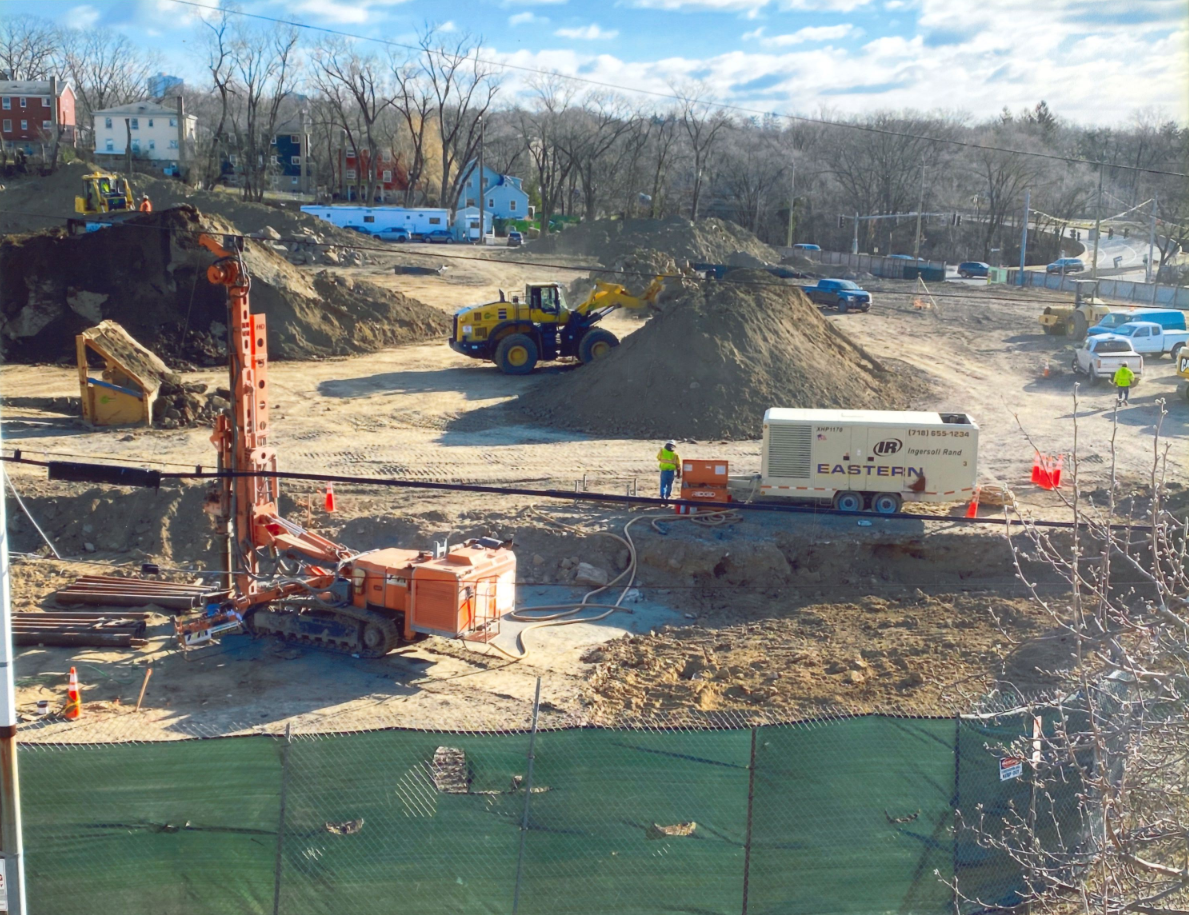
Injecting materials into soil or rock to fill voids and increase strength.
Permeation Grouting
Low-viscosity grout injected under pressure, fills pores without disturbing soil.
Used For: sands, gravels, fissured rock.
Compaction Grouting
Thick grout bulbs injected under pressure to displace and densify surrounding soils.
Used For: settlement correction, underpinning.
Jet Grouting
High-pressure jets of water-cement mix erode and replace soil to form soil-cement columns (2–6 ft diameter).
Used For: foundations, cutoff walls, underpinning.
Fracture (Fissure) Grouting
Creates fractures in stiff clay or rock and fills them with grout to improve drainage or strength.
B . Inclusion Methods
Introduce reinforcing elements or columns into the ground.
Stone Columns (Vibroreplacement)
Columns of compacted gravel installed via vibroflot.
Increases strength, reduces settlement, and improves drainage.
Effective in soft clays and sands.
Deep Soil Mixing
Mixing soil in situ with cement or lime slurry using rotating augers.
Forms soil-cement columns for strength and stiffness.
Used under embankments, tanks, and foundations.
Ground Improvement
Ground improvement refers to a set of engineering techniques used to enhance the properties of soil or rock — such as strength, stiffness, density, or permeability — to make it more suitable for construction.
It’s a key part of geotechnical engineering, especially when natural soil conditions are weak, compressible, or unstable.
Ground improvement modifies the engineering behavior of in-situ soils to: